
Start With Your Customer: A 3-Step Framework for Retail Brands
The secret that keeps retail businesses from achieving growth? They aren’t marketing to their one ideal customer.
One question we ask every founder we talk to is, “Who is your customer? Who do you help?” And I can tell you it’s a red flag when they answer, “Really, we help all women.”
To me, that answer screams that they haven’t done their homework yet. They haven’t dialed in on who it is that they are really targeting. So when they go to message their brand, they are shouting to the masses rather than appealing to a single, specific person.
Identify one specific person
Yes, you might tell me that you have a range of customers – and that is ok. But your marketing messaging, your photoshoots, your merchandising… all of that should be geared towards your single target audience.
And I want you to be specific. I’m not asking for a demographic, or a persona. I’m asking you to create one specific person in your mind that you are creating all of your marketing for.
Think about it:
What is her name?
How old is she?
Where is she going?
What’s going on in her life?
What are her interests?
Why does she shop?
Being specific is what will make the right person feel seen.
Example: Meet Claire – Claire is 38 and has become increasingly more intentional about how she spends her time and money. She’s over chasing trends and buying clothes that fall apart and wants to build a wardrobe of pieces that actually last and that feel truly “her.” She needs fully styled looks for dinners with friends, work events and the occasional weekend trip. She values quality over quantity, and she’s willing to pay more for something that fits like a glove. Her days are full - with a husband, a young child, and a social calendar - so she doesn’t have endless time to shop. She wants to walk in, feel seen and cared for, and walk out with what she needs - along with a gift to take to her next dinner party.
Identify the problem you solve
From there, you can really start to understand what problem you can solve for her. Spoiler alert: retail shopping is never just about buying nice things.
Think about the actual words she uses when she shops with you. Read reviews and testimonials to uncover what she enjoys about her experience in your shop/with your product. Or even better, conduct an informal interview or focus group.
Questions to ask:
What are they experiencing right now?
What do they want instead?
Why has their current approach failed them?
Example: She has a sense of who she is and how she wants to show up in the world — polished, put-together, real. But finding clothes that match that vision is exhausting. The options in her market are either too casual, too trendy, or too intimidating — stores where the clothes are beautiful but the experience makes her feel like she doesn't belong. So she settles for good enough, drives hours to a major city, or spends her evenings scrolling online trying to piece together a wardrobe without ever feeling truly seen or served.
Identify why you are the clear answer
This is your position in the market. The goal here is to make it easy for your ideal customer to understand why you are the obvious choice. Think about what you believe, and why they should listen to you. Don’t get caught up in flowery language, just state this as plainly as you can.
Example: [Store] exists to be the store she's always wanted. It is the place where elevated taste meets genuine warmth — where the curation is done for her, the staff actually knows her, and walking in feels like visiting a friend who happens to have exceptional taste. She doesn't have to explain herself or earn her place. She just gets to feel good. [Store] gives her the experience that most women in this market have never had locally: a beautiful store that also makes her feel like she belongs.
Once you nail down these 3 steps, it will be much easier to market your brand, because you will know who you’re talking to and what you want to say to them.
You know what models to select, because your customer wants to see herself in the imagery
You know what events to talk about, because you know how she spends her time
You know what pain points you’re solving for, and you can speak to the gap so she feels seen
Attracting the right people, and repelling everyone else
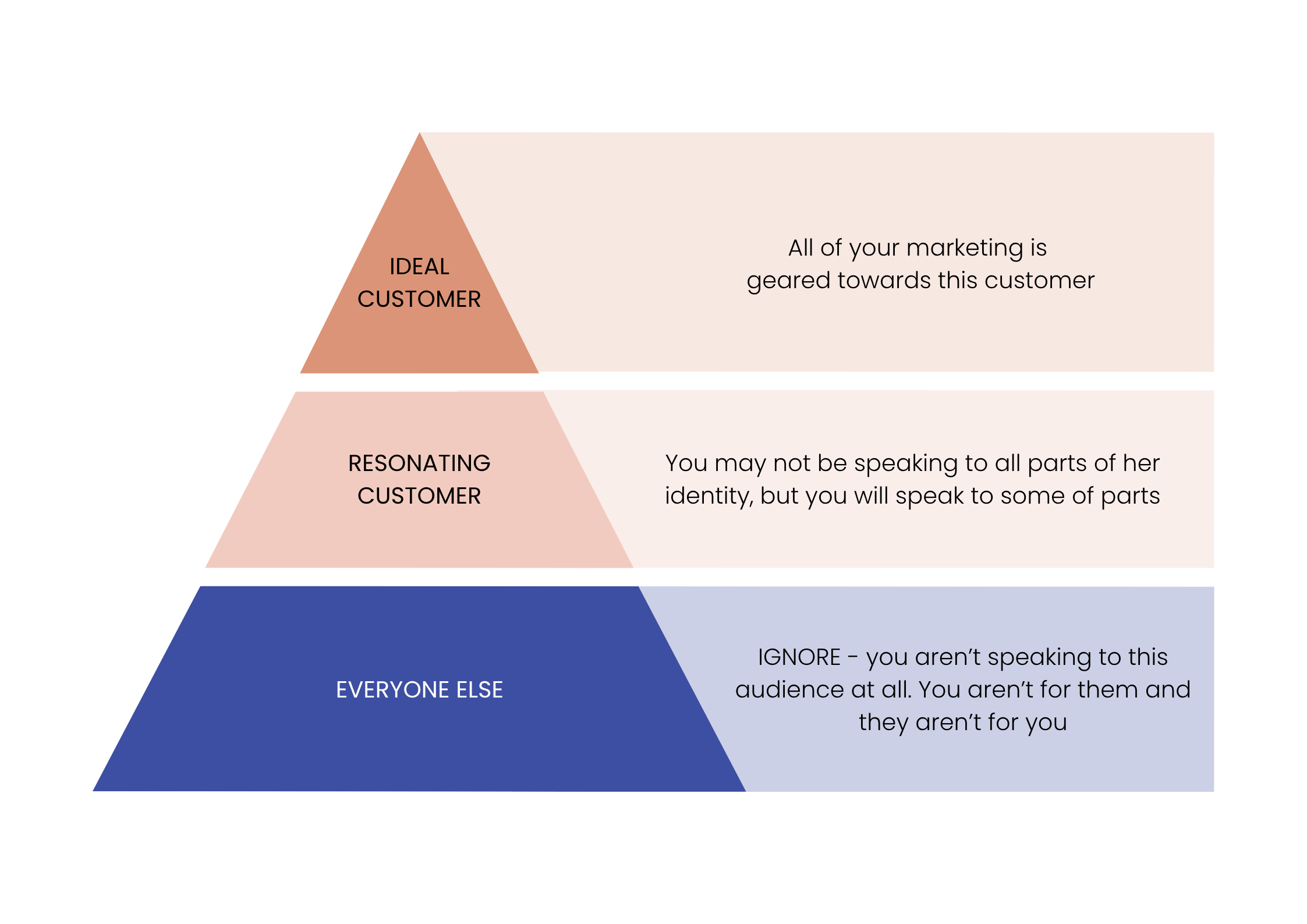
Here’s the thing - we all have a range of customers. The key is that if we’re speaking to our ideal customer, we’re also going to attract the people around her who may identify with some of your brand. The most helpful way we can think about this is like a triangle. At the top, you have your ideal customer, this is your smallest section. The widest section at the bottom is everyone you are not for. And in the middle are the customers who fit in the range – those that fall on the shoulder of your ideal customer.
Example: Let’s return to our example of Claire, who is 38. This boutique also has a customer who is 28 and a customer who is 48. Because the shop’s marketing is all designed to appeal to Claire, it will also speak to our 48 year old customer, who wants to feel like she’s shopping somewhere modern and young. It will also appeal to the more mature side of our 28-year-old, perhaps she will get her work clothes here. But if the marketing was all made to appeal to a younger audience, it would repeal the older shopper unintentionally.
In a world full of content and AI slop, it’s more important than ever to make sure your marketing stands out – and the best way to do that is to talk to the right person, the one person who you are truly trying to attract. Get clear on this, integrate it into all your marketing and watch your business grow.
FAQs
What does it mean to market to "one ideal customer"?
It means building your brand messaging, photography, and merchandising around a single, specific person — not a broad demographic. Instead of targeting "all women" or a vague age range, you create one detailed profile (name, age, lifestyle, values) and speak directly to her in everything you produce.
Isn't narrowing my target customer going to shrink my sales?
No — in practice it does the opposite. Customers who share values or lifestyle traits with your ideal customer (the "shoulder" audience) will still feel spoken to, even if they don't match every detail. Speaking clearly to one person creates messaging sharp enough to resonate broadly, while vague messaging aimed at "everyone" tends to connect with no one.
How specific should my ideal customer profile be?
Very specific — more specific than a typical marketing persona or demographic breakdown. You should be able to answer questions like her name, age, what's going on in her life, where she's going, and why she shops. The goal is a person you can picture, not a data segment.
How do I figure out the problem I actually solve for my customer?
Look past the product itself. Read customer reviews and testimonials, or conduct informal interviews, and pay attention to the actual language customers use. Ask what they're experiencing now, what they wish were true instead, and why other options have fallen short for them.
What's the difference between my ideal customer and my "position" in the market?
Your ideal customer is who you're talking to. Your positioning is why you're the answer for her — stated plainly, without marketing fluff. It should explain what makes your experience or product different from every other option she's already tried.
What if I have customers across a wide age or demographic range?
That's normal and expected. Think of it as a triangle: your ideal customer sits at the top, a wider "shoulder" audience sits in the middle, and everyone else falls at the bottom. Marketing built for your ideal customer will still resonate with people just outside that exact profile — as long as your messaging stays specific rather than trying to please everyone at once.