
How to Segment your Email List to Increase Revenue for your DTC Brand
TL;DR Email list segmentation breaks up your list into categories depending on customer behavior, purchase history and engagement so you can send them personalized content instead of blasting one message to your whole list. This blog post breaks down how to segment your list so you can drive more revenue from your email marketing.
If you run an ecommerce brand, someone has likely told you to segment your email list. And while we wholeheartedly agree with the statement, as always, we shy away from giving blanket advice. There's nuance to segmentation. An overly segmented list can actually hurt results, so finding the right balance for your brand is key.
That's why we're walking through our top recommendations for list segmentation.
What is email segmentation?
Email list segmentation is the practice of dividing your subscribers into smaller groups based on customer behavior, purchase history and engagement, so you can send each group content that's actually relevant to them instead of blasting one message to your whole list.
Think about the difference between two people on your list. One is a first-time subscriber who found you through a Reel last week and hasn't bought anything yet. The other is a customer who has placed four orders in the past year and opens nearly everything you send. Sending them the same email treats two very different relationships as if they were identical. Segmentation is how you stop doing that.
Why emailing everyone is hurting your results
When every send goes to your entire list, two things quietly work against you.
Deliverability. Mailbox providers like Gmail, Apple and Yahoo decide where your email lands based on how people engage with it. When you repeatedly send to subscribers who never open or click, those providers read it as a signal that your email isn't wanted, and your sender reputation takes a hit. The frustrating part is that this doesn't just affect the unengaged people. It affects everyone. Your best customers start seeing you in the promotions tab, or the spam folder, because of behavior from subscribers who stopped paying attention months ago. Limiting who you send to is one of the most direct ways to protect your inbox placement for the people who actually want to hear from you.
Non-personalized content. A brand-new subscriber and a loyal repeat customer are not in the same place, and they shouldn't get the same email. The new subscriber needs a reason to make a first purchase. The repeat customer already trusts you and is ready for the next product, the early access, the loyalty perk. When you send one generic message to both, you water it down for everyone. Relevance is what drives opens, clicks and revenue, and you can't be relevant to people you're treating as a single undifferentiated group.
Engagement based segmentation
Engagement segmentation groups people by how recently and how actively they've interacted with you. It's the foundation, because it protects your deliverability and tells you who's actually worth sending more to.
Walk: For smaller or younger lists, start simply with two tracks, active and inactive subscribers
Active (has clicked, been active on site, or placed an order in the past 180 days)
Content to send them: This list should receive most or all of the content you send.
Inactive (has not clicked, been active on site, or placed an order in the past 180 days)
Content to send them: Major sales and promotions only, plus dedicated content meant to win them back.
This alone does a lot of the work. You keep showing up consistently for the people engaging with you, and you stop dragging your sender reputation down by emailing people who have gone quiet.
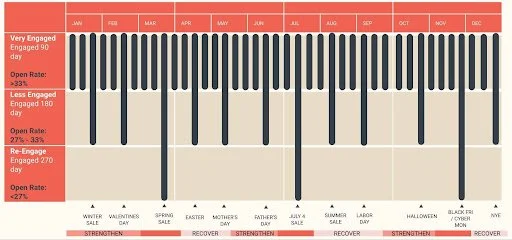
Run: If your list is larger, more established (you've been growing it for a couple of years), or you're more comfortable with segmentation, you can take your engagement based segmentation to the next level by adding additional tracks and varying your sending cadence based on how engaged the subscriber is.
Highly Engaged (has clicked, been active on site, or placed an order in the past 30 days)
Content to send them: 5 to 6 emails per week, or all of the content you send.
Very Engaged (has clicked, been active on site, or placed an order in the past 90 days)
Content to send them: 3 to 4 emails per week, or most of the content you send.
Somewhat Engaged (has clicked, been active on site, or placed an order in the past 180 days)
Content to send them: 1 to 2 emails per week, your top performing content.
Not Engaged (has not clicked, been active on site, or placed an order in the past 180 days)
Content to send them: Major sales and promotions only, plus dedicated content meant to win them back.
The logic here is simple. The people who want to hear from you most should hear from you most, and the people who've drifted should hear from you rarely and intentionally. Matching frequency to engagement is how you increase total revenue without increasing unsubscribes.
Purchase Behavior segmentation
Engagement tells you who's paying attention. Purchase behavior tells you where someone is in their relationship with your brand, which shapes what you should actually be saying to them.
Walk:
Purchasers (has placed at least one order)
Content to send them: These people have already trusted you with their money, so stop selling them on the first purchase and start nurturing the next one. Prioritize post-purchase flows, replenishment or restock reminders where it fits the product, cross-sells based on what they bought, review requests, and early access to new arrivals.
Non-purchasers (subscribed to email but hasn't placed an order)
Content to send them: If you have a welcome offer, include this in all of the content they receive so they are continually reminded that the offer is waiting for them. This segment should also receive content that builds trust, like brand story and social proof.
Run: Once you're ready to go deeper, break your customers into stages and speak to each one differently.
High value prospects: Non-purchasers who are showing real buying signals, like browsing repeatedly, clicking through to product pages, or sitting on an abandoned cart. They've told you they're interested.
Content to send them: Give them a reason to act, whether that's the welcome offer, social proof, or a clear answer to whatever's holding them back.
First-time buyers: The most fragile and most important group. One purchase doesn't make a loyal customer, and the window right after that first order is where you either earn a second one or lose them.
Content to send them: Lean into a strong post-purchase sequence that reinforces they made a great decision and gently introduces the next product.
Repeat and VIP buyers: Your most valuable customers and the ones too many brands take for granted. Treat them like insiders.
Content to send them: Early access, a loyalty tier, occasional perks that feel exclusive, content that makes them feel like part of the brand rather than a name on a list. These are the repeat purchases that quietly carry your revenue, so protect the relationship.
Lapsed buyers: People who used to buy and have gone quiet. They already know and trust you, which makes them far easier to bring back than acquiring someone new.
Content to send them: A focused winback sequence, a reason to return, and a reminder of why they loved you in the first place will often do the work.
How to set up basic segments in Klaviyo today
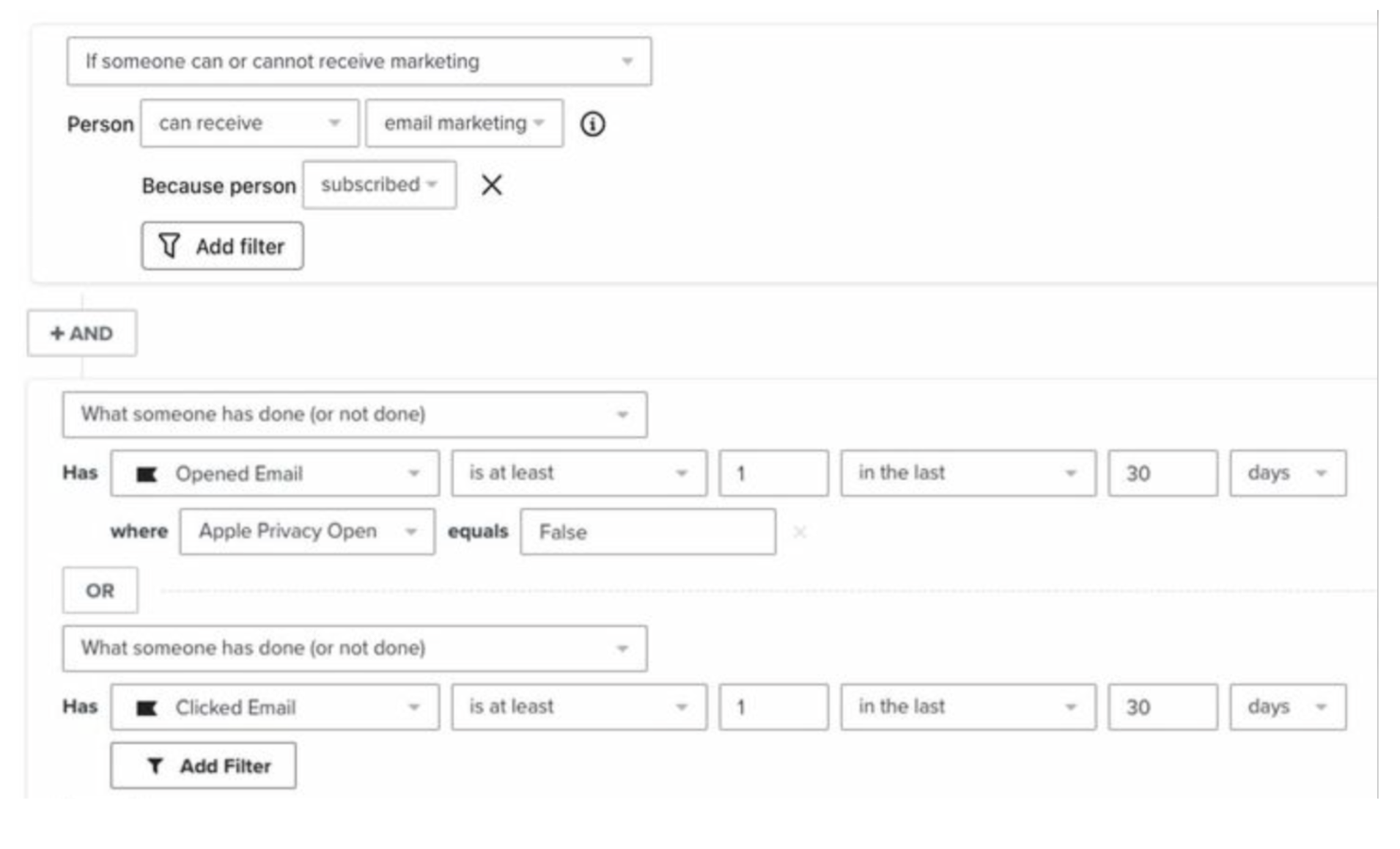
In Klaviyo, head to Audience > Lists & Segments > Create List / Segment > Segment, then build your conditions in the definition editor.
A few starting segments worth building today:
Engaged subscribers (30 day): Use the condition What someone has done (or not done) > Opened Email or Clicked Email at least once over the last 30 days, and add Active on Site or Placed Order with OR logic if you want a fuller engagement picture. This becomes the audience you can confidently send to most often. (Note that since Apple's Mail Privacy Protection inflates opens, clicks are the more reliable engagement signal here.)
Non-purchasers: Use What someone has done (or not done) > Placed Order > zero times over all time. This is the group that should always see your welcome offer.
First-time buyers: Placed Order equals 1 over all time. Pair this with your post-purchase content.
Lapsed customers: Placed Order at least once over all time combined with Placed Order zero times in the last 120 to 180 days. This is your winback audience.
Build a small handful, send to them consistently for a few weeks, and let the results tell you where to go deeper.
What a realistic performance lift looks like from segmentation
When segmentation is done well, the lift shows up across every metric that matters. In Mailchimp's analysis of segmented versus non-segmented campaigns, the segmented sends delivered:
Open rate: 14% higher
Click rate: roughly double (100% higher)
Unsubscribe rate: 9% lower
On the revenue side, the Data & Marketing Association attributes 25 to 30% of email revenue to segmented sends.
The throughline is that relevance pays. When people get content that fits where they are, they open more, click more, buy more, and opt out less.
The segmentation mistakes to avoid
Segmentation is powerful, but more is not always better. Two mistakes show up constantly.
Segmenting a list that's too small. If you only have a few thousand subscribers, slicing them into eight tiny groups leaves you with audiences too small to send meaningfully or learn anything from. Start with the Walk version, build a real base of engagement and purchase data, and add complexity as your list grows into it.
Creating micro segments that diminish results. It's tempting to keep narrowing, but every additional segment is another audience to create content for and another group small enough that the numbers stop being reliable. The goal isn't the most segments. It's the right ones. A handful of well-defined, well-fed segments will always outperform a sprawling system you can't actually maintain.
Our best advice: Think about the actual persona you want to reach (i.e. a first time buyer), and what content you want to send them. Then create a segment based on their parameters. Don’t create segments for the sake of it.
Let's look at your list together
You're likely sitting on more revenue than your list is currently producing, and segmentation is one of the most direct ways to unlock it. If you want a second set of eyes on how your list is structured and where the easy wins are, let's look at your list together.