
LTV vs CAC: The Metrics Every Ecommerce Founder Needs to Understand
LTV:CAC is a ratio that gets thrown around a lot in ecommerce, and for good reason. It is one of the best indicators of product-market fit and long-term sustainability in your business. It is also one of the least understood metrics in the industry – which is exactly why this post is breaking it down in terms that are actually useful.
If you are at the $2M to $5M stage and your growth is starting to feel expensive, this number is usually where the answer lives.
What LTV and CAC actually mean
Customer acquisition cost (CAC) is what you spend to win one new customer. Take your total marketing and sales spend over a given period and divide it by the number of new customers acquired in that same period. If you spent $20,000 in Q1 and acquired 400 new customers, your CAC is $50.
Customer lifetime value (LTV) is the total revenue a customer is expected to generate across their relationship with your brand. A simple starting calculation: average order value multiplied by average purchase frequency multiplied by average customer lifespan. If your AOV is $90, customers buy an average of 2.5 times per year, and they stay active for about two years, your LTV is $450.
Neither number is particularly useful in isolation. The ratio is where the insight lives.
LTV:CAC Why the ratio matters more than either number alone
A CAC of $200 might sound manageable until you realize your LTV is only $220. On the other hand, if your CAC is $50 and your LTV is $220, then you’re in pretty good shape. The ratio reveals how much margin actually exists between what you spend to get a customer and what that customer gives back.
How to calculate your LTV:CAC ratio today
You do not need a finance team for this. Here is a simple version you can run right now:
Add up your total marketing spend (ads, agency fees, tools) for the last 12 months.
Divide by the number of new customers acquired in that period. That is your CAC.
Pull your average order value from Shopify. Multiply by your average orders per customer (also in Shopify under customer reports). Multiply by an estimated customer lifespan in years – start with 2 if you are unsure. That is a working LTV estimate.
Divide LTV by CAC. That is your ratio.
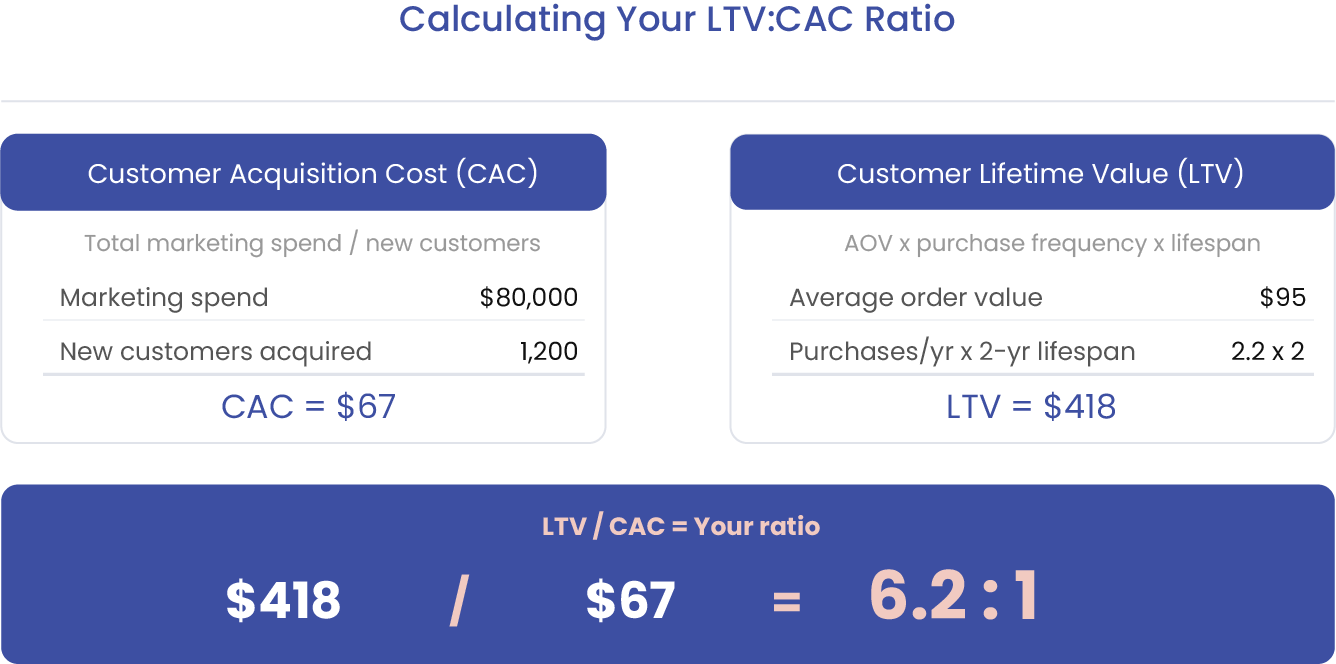
Example: You spent $80,000 on marketing last year and acquired 1,200 new customers. CAC = $67. Your AOV is $95, customers buy an average of 2.2 times per year, and you estimate a two-year lifespan. LTV = $95 x 2.2 x 2 = $418. LTV:CAC = $418 / $67 = 6.2:1.
That ratio looks strong – but only if the numbers underneath it are real. A high ratio with a low repeat purchase rate often means your LTV estimate is too optimistic. The calculation is a starting point, not a final answer.
So what is a healthy LTV:CAC ratio?
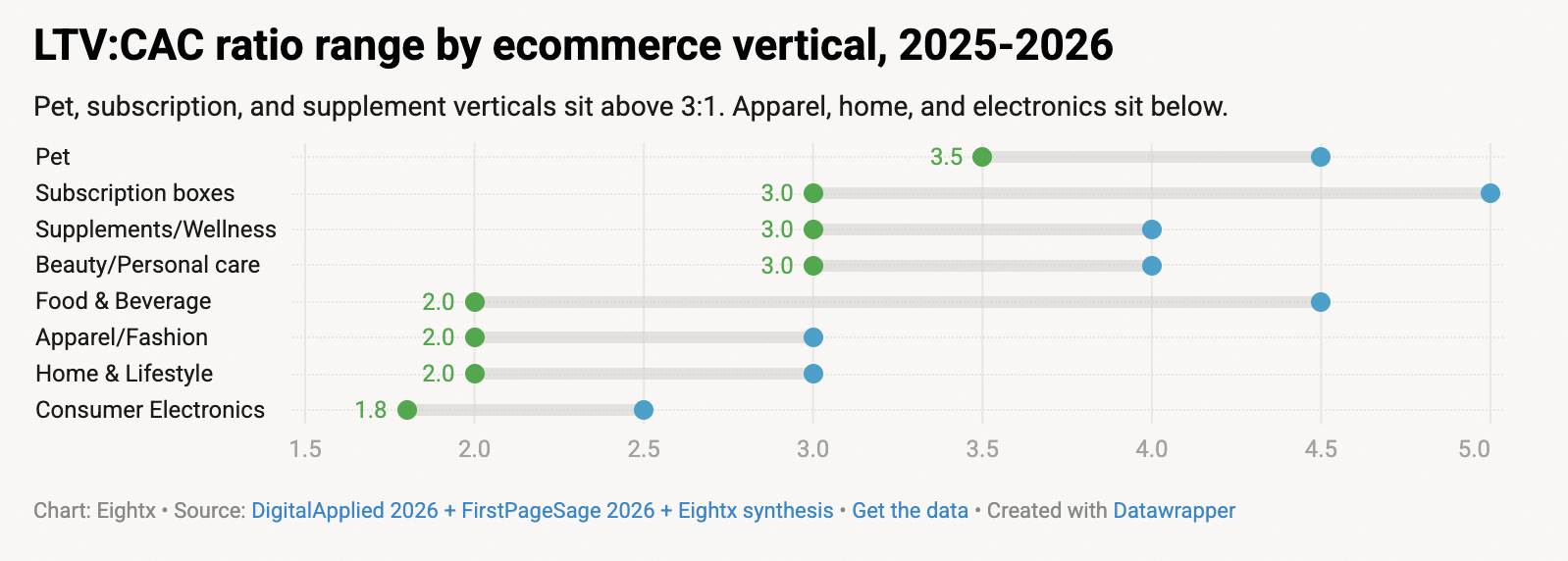
For years, the benchmark ratio of 3:1 has been touted as the golden rule for LTV:CAC. And you can certainly use that as a guide. However, there is nuance depending on what vertical you’re in.
According to data compiled by Eightx from DigitalApplied and FirstPageSage (2026), apparel and fashion brands typically see a median LTV:CAC starting point of 2:1, with stronger performers reaching 2.5:1 to 3:1. Beauty and personal care brands show a median of 3:1, with top performers reaching 3.5:1 to 4:1. Supplements and wellness brands follow a similar pattern.
To improve your ratio you have two options: increase your LTV or lower your CAC.
The difference between brands falling near the median and the top-performers? It isn’t typically what they spend on ads… It’s everything they’re doing after the first purchase. In other words, increasing LTV is the bigger lever, not lowering your CAC.
How rising ad costs are squeezing CAC
Cost per click on Meta has increased substantially year over year, and the brands most exposed are the ones under-invested in their owned channels. When your primary acquisition lever gets more expensive and your LTV stays flat, the ratio deteriorates in real time.
On top of that, as CAC climbs, founders tend to spend more on acquisition to maintain revenue – which drives CAC higher still. Without a corresponding increase in LTV, you end up on a treadmill: working harder, spending more, and keeping less.
The exit from that loop is not finding cheaper ads. It is increasing what each customer is worth over time.
The LTV lever: how email and loyalty move the number
LTV is a function of three things: how much customers spend per order, how often they come back, and how long they stay engaged with your brand. Email and loyalty programs are the most direct ways to impact all three of these.
Email flows – specifically post-purchase sequences, win-back campaigns, and VIP nurture – work by staying in contact with customers at the moments most likely to drive a second, third, or fourth purchase. A post-purchase flow that introduces complementary products and reinforces brand trust increases both order frequency and AOV. A win-back flow that re-engages lapsed customers extends lifespan. Over time, these touchpoints accumulate into measurable LTV lift.
Segmentation matters here too. Sending the same message to your entire list drives unsubscribes and deliverability issues that erode long-term engagement. Segmenting by purchase behavior allows you to send the right message to the right customer at the right stage of their lifecycle, which drives higher click rates, higher conversion, and stronger retention.
Loyalty programs address the lifespan component directly. When customers have a reason to return – points, early access, VIP tiers – you extend their active window with your brand. Even a simple referral mechanic or points-based system can meaningfully increase purchase frequency among your most engaged buyers.
Together, these tactics move the LTV side of the ratio without requiring you to spend more on acquisition. That is the most efficient way to improve the number.
What to do if your ratio is off
If your ratio is sitting at or below the median for your vertical – 2:1 for apparel, 3:1 for beauty and wellness – the most direct path to improving it is building the retention infrastructure that drives repeat purchase. That means:
Reviewing your Klaviyo flows – specifically whether post-purchase, win-back, and browse abandonment sequences are live, optimized, and actually firing.
Introducing segmentation – at minimum, separating engaged subscribers from unengaged ones, and first-time buyers from repeat buyers.
Evaluating whether a loyalty program makes sense at your stage – even a simple referral program or points system can move purchase frequency among your best customers.
Look at what else happens for the customer post-purcase. How is your customer service follow up? Are you engaging with customers on social media? Every channel is an opportunity to bring them further into your brand world.
If you want to dig into what your retention strategy should look like at your specific revenue stage, this post on customer retention strategies for ecommerce brands covers the full framework.
Want to run the numbers on your brand? Book a free strategy session and we will walk through your LTV:CAC ratio together, identify where your retention is leaking, and map out the highest-leverage place to start.
Frequently Asked Questions
What is a good LTV:CAC ratio for an ecommerce brand?
A good starting point is 3:1, but really, it depends on your vertical. Apparel and fashion brands typically see a median starting point of 2:1, with top performers reaching 2.5:1 to 3:1. Beauty and personal care brands show a median of 3:1, with top performers at 3.5:1 to 4:1. Supplements and wellness brands follow a similar pattern. The more useful question is not whether you hit a universal number – it is whether you are at the top or the bottom of your vertical's range, and what is driving the difference.
How do I calculate customer lifetime value for my brand?
A practical starting formula: average order value multiplied by average purchase frequency (orders per customer per year) multiplied by average customer lifespan in years. You can pull AOV and purchase frequency directly from Shopify's customer reports. Lifespan requires a bit more judgment – start with two years as a working estimate if you do not have cohort data.
What is the fastest way to improve my LTV:CAC ratio?
The fastest lever is usually email – specifically optimizing your post-purchase flow to drive a second purchase and your win-back flow to recover lapsed customers. Both improve purchase frequency without any additional acquisition spend. If your flows are already live and performing, the next layer is segmentation, which increases conversion rates across every send.
Does a loyalty program actually improve LTV for small ecommerce brands?
Yes, but the setup matters. Remember that the biggest LTV driver in a loyalty program is not the points themselves – points incentivize repeat purchases. Even a simple program that rewards a second purchase meaningfully increases average customer lifespan. The key is connecting your loyalty program to your Klaviyo flows so the touchpoints are automated and consistent.