
Customer Retention Strategies for Ecommerce Brands: What Actually Moves the Needle
Acquiring a new customer costs five times more than keeping one. Most ecommerce brand founders know this. Most still spend the majority of their marketing budget on acquisition.
It’s not that founders and marketing leaders don’t care about retention. It’s that acquisition is louder. Acquisition takes a significant amount of ad spend, so it makes sense that you are going to pay attention to the results. Retention is quieter and easier to put on the back burner. Until the day you realize your ROAS (return on ad spend) is slipping, your CAC (cost of customer acquisition) has climbed for the third year in a row, and the customers you paid to acquire aren’t coming back.
This post is the wake-up call and the roadmap. If you’re an ecommerce brand generating $1-$10 million in revenue, it covers exactly what customer retention looks like, which levers actually move the needle, and where to start if you haven’t built anything yet.
The Acquisition Trap (And Why So Many DTC Brands Are Stuck In It)
Paid acquisition works right up until it doesn’t. Meta and Google can drive consistent new customer volume, and when they’re performing, it’s easy to keep reinvesting. The problem isn’t that paid ads are bad. The problem is that most DTC brands have built their entire revenue model on top of them.
Here’s what that looks like in practice:
CAC climbs year over year as competition for ad inventory increases
ROAS looks acceptable until a platform algorithm shifts, iOS privacy changes, or a competitor enters the market
Revenue grows, but margins don’t, because you’re spending more to get each dollar in the door
The customers you’re acquiring aren’t sticking around, so you need to acquire even more to hit your numbers next month
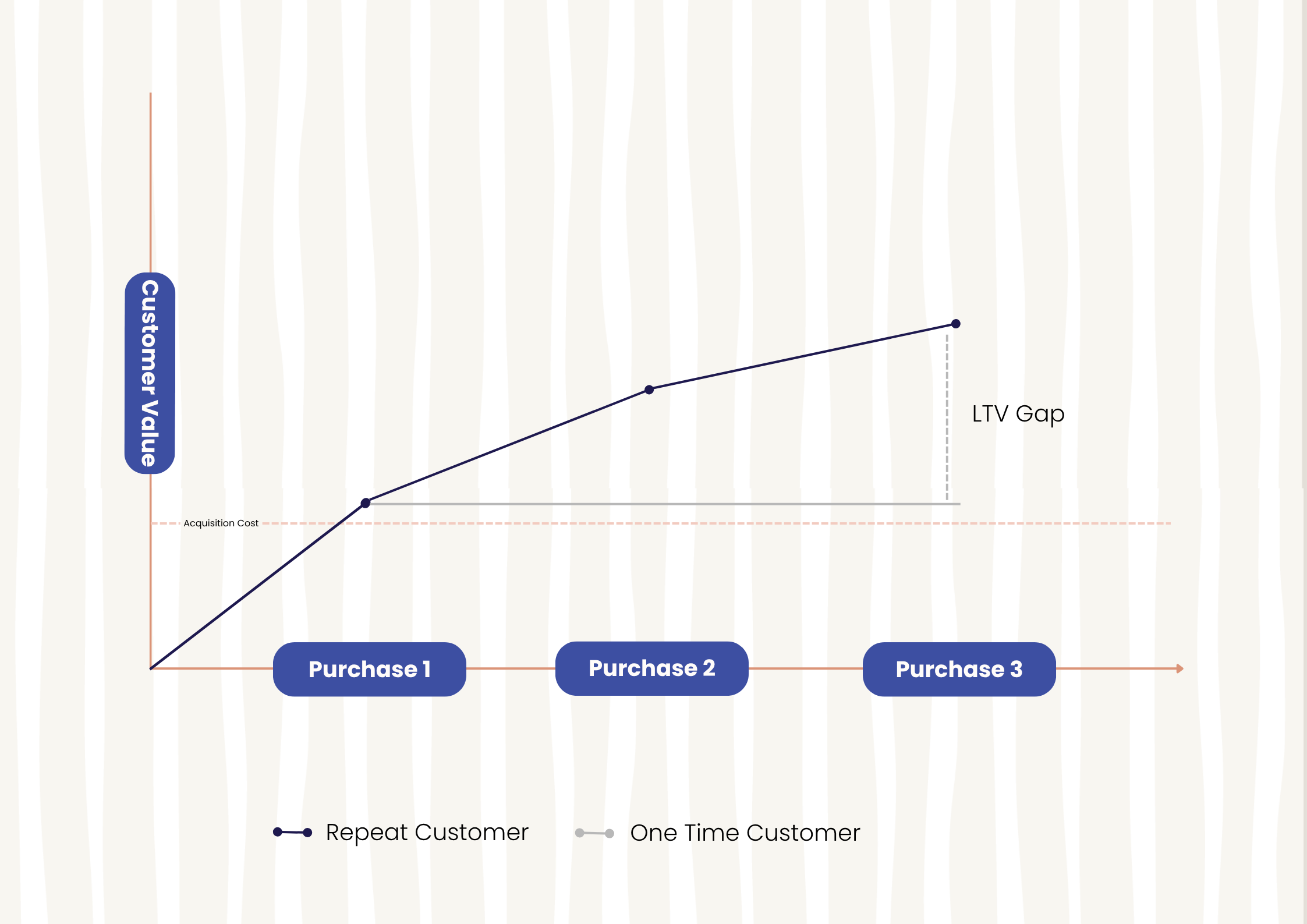
The solution? Addressing customer retention. Having strong customer retention helps you increase customer lifetime value, and reduces how hard your ads have to work. The brands that scale efficiently aren’t the ones with the best ad creative. They’re the ones who figured out how to keep the customers they already paid to get.
What Retention Actually Means for a DTC Brand
Before getting into tactics, it’s worth defining what retention actually is, and what metrics are the most important to measure. Put simply, customer retention is getting a previous customer to come back and buy again. We measure retention by the following metrics:
Lifetime Value (LTV)
Lifetime value is the total revenue a customer generates over their entire relationship with your brand. It’s the number that determines whether your acquisition cost is sustainable. If you’re spending $60 to acquire a customer who only ever buys once and spends $55, you have a retention problem, not an acquisition problem.
Repeat Purchase Rate
Repeat purchase rate is the percentage of your customers who buy from you more than once. For most DTC brands at the $1–$10M stage, a healthy rate falls between 20–40%, depending on your business stage, category, and average order frequency. If you don’t know yours, pull it from Shopify today. It will tell you a lot.
Churn
Churn is the rate at which customers stop buying. High churn means you’re constantly replacing customers rather than compounding the ones you already paid to acquire. A brand with strong retention doesn’t just grow; it grows more efficiently every year, because the same acquisition spend goes further.
The Three Levers of DTC Retention
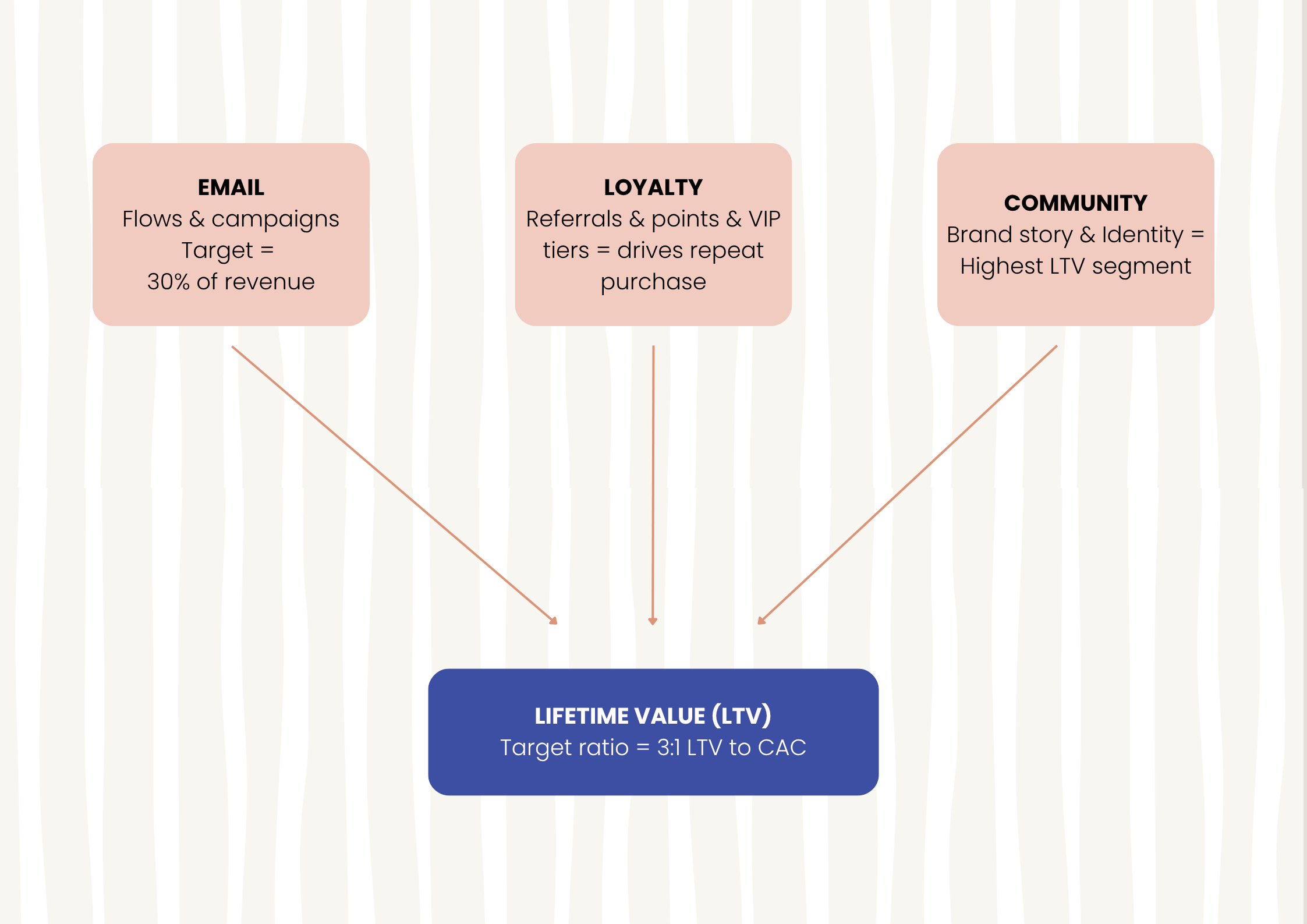
There are many factors that impact customer retention, like customer service and simplified returns, but for a DTC brand’s marketing, it really comes down to three things: email marketing, loyalty programs, and community. Each one does a different job, and they work better together than in isolation.
Email & SMS marketing are your highest-leverage owned channels. They are direct, measurable, and when set up correctly, should drive 30% of your ecommerce revenue.
Loyalty programs create structured incentives for repeat purchase. They don’t need to be complicated to work; they just need to reward the behavior you want.
Community and brand story are what turn transactional customers into loyal ones. Customers who buy the identity, not just the product, have significantly higher LTV.
You don’t need all three on day one. But you do need a plan for all three, because relying on any single lever leaves you exposed. Check out our post about which channels to prioritize at every stage of business growth for more on this.
Email Marketing as a Retention Engine
Email marketing is the foundation of your retention marketing strategy. It’s the channel you own, the one that doesn’t depend on an algorithm, and the one with the clearest line to revenue. And if you layer in SMS marketing, you’re ahead of the competition.
A good benchmark to use is 20-40% of your ecommerce revenue should be from email, with 30-50% of email revenue coming from flows. If these numbers look off to you, or you don’t have all of your key flows in place, here’s are the basics of a retention-focused email marketing strategy:
The Flows That Drive Retention
Most brands have the acquisition flows covered. What they’re missing are the flows that keep customers coming back.
Post-purchase series: This is your most important retention flow and the most underbuilt. A strong post-purchase series sets expectations, builds trust, surfaces product education, and creates the window for a second purchase, before a customer has a chance to forget why they bought from you.
Winback flow: A well-built winback sequence can recover 5–15% of lapsed customers. If you don’t have one, you’re leaving a meaningful revenue recovery on the table every single month.
VIP flow: Your top customers (the ones who buy repeatedly and spend the most) deserve to be treated differently. A VIP flow rewards that behavior and reinforces it. These customers already trust you; the goal is to deepen that relationship.
Browse abandonment: A customer who browses but doesn’t buy is still warm. Browse abandonment flows re-engage them at the right moment, before they forget what they were looking at.
Campaigns That Keep Customers Engaged Between Purchases
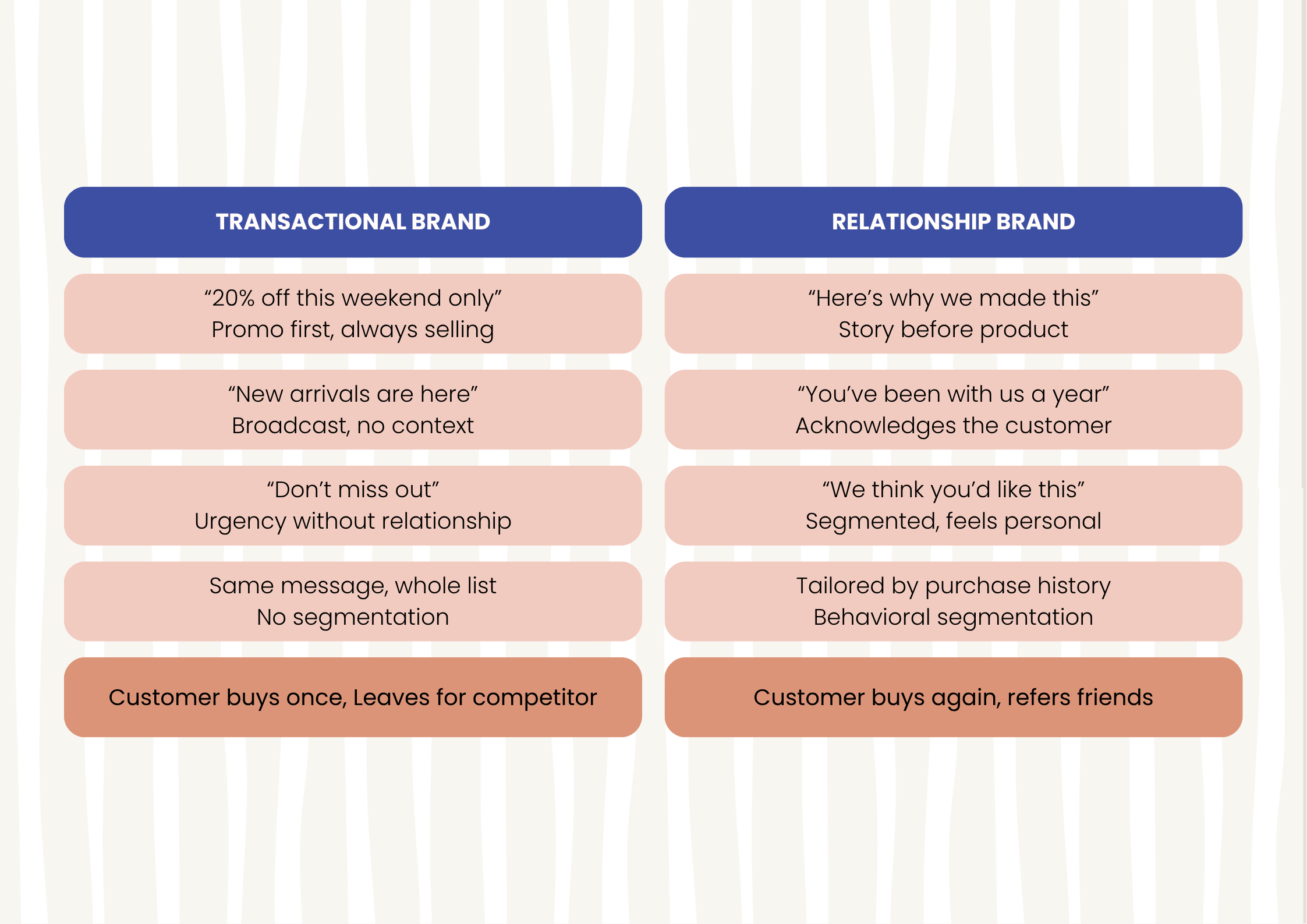
Flows handle the automated touchpoints. Campaigns are how you stay relevant between purchase cycles. The brands that do this well don’t just send promotions; they use campaigns to reinforce brand narrative, share product stories, educate, and build the kind of relationship that makes customers choose them over a cheaper alternative.
A few principles:
Send consistently, not sporadically. Your cadence will depend on your brand’s size and business stage, but you want to work up to daily email campaigns.
Segment before you send. Sending the same email to your entire list is the single biggest revenue leak in most DTC email programs. At minimum, separate engaged subscribers from unengaged ones, and treat first-time buyers differently from repeat customers.
Make it about them, not you. The best retention emails feel like communication from a brand that understands who the customer is, not a broadcast from a company trying to hit a revenue target.
What Good Email Retention Looks Like in Numbers
If your email program is working as a retention engine, you should see:
20–40% of total revenue attributed to email (depending on your business stage)
30-50% of your email revenue coming from flows
Repeat purchase rate improving over a 90-day period
Winback flow recovering 5–15% of lapsed customers
Post-purchase open rates above 40% and click rates above 6% (this is your warmest audience)
Loyalty Programs That Work for Lean Teams
Loyalty programs have a reputation for being complicated and enterprise-level. Ecommerce brands often fall into one of two categories: they haven’t launched a loyalty program because they are worried it will be too much work OR their existing program is too generous and is cutting into their profit margin.
A loyalty program doesn’t need to be sophisticated, but it does need to be strategic. It needs to do two things: increase repeat purchase rate and increase LTV. If your program doesn’t do those two things, the mechanics don’t matter.
Phase 1: Referral Program
The simplest loyalty mechanic and often the highest ROI. A referral program turns your existing customers into acquisition channels, which is particularly valuable when your CAC is already high. Tools like ReferralCandy or even a manual structure work at this stage. You don’t need to overcomplicate it.
Phase 2: Points-Based Rewards
Points programs work well once you have enough purchase volume to make them meaningful. The key is keeping it simple: earn points on purchases, redeem for discounts or early access. Tools like Smile.io or Yotpo (our preferred partner) are built for lean DTC teams and integrate with both Shopify and Klaviyo.
The most common mistake is making the earning and redemption thresholds too high or too complicated. If customers can’t realistically redeem anything, the program doesn’t change behavior.
Phase 3: VIP Tiers and Early Access
For your highest-value customers, status matters. A simple VIP tier (early access to new products, exclusive communication, first look at sales) deepens loyalty without requiring heavy spend. These customers are already choosing you. The goal is to make them feel seen for it.
Connecting Loyalty to Email
A loyalty program that lives only on your website is a missed opportunity. Connecting it to your Klaviyo flows: triggering emails at reward milestones, alerting customers when they’re close to a redemption threshold, and sending VIP-specific campaigns. That is what turns a loyalty program from a passive feature into an active retention tool.
Ready to get started? Here’s even more guidance on getting started with a loyalty program.
Community and Brand Story as Retention Tools
The customers with the highest LTV aren’t just buying your product. They’re buying into your brand lifestyle, and everything you represent. That kind of loyalty isn’t manufactured through a points program; it’s built through consistent brand narrative, meaningful communication, and the sense that the brand actually knows who they are.
For a lean DTC team, “community” can be as simple as:
Using email to tell the brand story over time
Featuring real customers in content
Letting the founder’s voice come through in communication: authenticity builds trust faster than polish
Acknowledging customer milestones: anniversaries, second purchases, birthdays through email flows
Engaging with customers on the platforms they are on (Instagram, TikTok) instead of being one-sided
As your business grows, community can also look like:
A close friends group on Instagram, a private Facebook group, or Slack community for your best fans
Meetups IRL with the brand founder
Pop-ups and events where you invite your best customers
The brands that do this well have customers who will choose them over a cheaper competitor without thinking twice. That’s not irrational; it’s what happens when a brand has invested in the relationship, not just the transaction.
Where to Start If You’re Doing Nothing: A 90-Day Plan
Month 1: Get Visibility
Before you build anything, understand where you are. Most founders who go through this step are surprised by what they find.
Pull your email revenue attribution in Klaviyo. Find out what percentage of revenue is currently coming from email: flows and campaigns separately.
Pull your repeat purchase rate from Shopify. If you don’t know this number, it’s almost certainly lower than it should be.
Audit which email flows are actually live and when they were last updated. A flow that hasn’t been touched since it was built isn’t an asset; it’s a liability.
Month 2: Fix the Foundation
Now that you know where you stand, fix the highest-leverage problems first.
Build or rebuild your post-purchase flow. This is the single highest-ROI thing most DTC brands can do for retention. If you have one, audit it. If you don’t, build it now.
Segment your list at a minimum into three groups: first-time buyers, repeat buyers, and lapsed customers. Start developing content with these three audiences in mind.
PRO-TIP: Add your welcome offer to every email that goes out to prospects. This will significantly improve your first-time buyer conversion rateCommit to a sending cadence. One to two campaigns per week, consistently, is significantly better than sporadic sends when you have bandwidth. Over time, increase your cadence until you are sending daily.
Month 3: Add a Loyalty Layer
Once the email foundation is solid, layer in loyalty mechanics.
Set up a VIP segment in Klaviyo and begin treating those customers differently in your campaigns. They’ve already told you they trust you. Acknowledge it.
Launch a referral program. It’s the lowest-lift place to start, and it turns your best customers into acquisition channels.
Start tracking LTV month over month. This is the number that tells you whether your retention efforts are working.
Not Sure Where Your Retention Is Leaking?
Most ecommerce brands at the $1–$10M stage are leaving real revenue on the table, not because they don’t care about retention, but because no one has mapped out what it should actually look like for their brand, at their stage, with their list.
That’s exactly what a retention audit does. We look at your email attribution, your flows, your sending cadence, and your repeat purchase data, and we show you where the gaps are and what to fix first. No vague recommendations. Just specific, prioritized answers.
FAQs
What is a good repeat purchase rate for a DTC brand?
A healthy repeat purchase rate for DTC ecommerce brands typically falls between 20% and 40%, depending on your business stage, category and average repurchase frequency. Consumables and skincare brands often see higher rates; apparel and lifestyle brands can sit toward the lower end of that range. Newer brands will also see a lower repurchase rate because customer acquisition is the priority for newer businesses. However, if your repeat purchase rate is below 20%, retention should be a top marketing priority, regardless of your business stage.
How much of my revenue should come from returning customers?
For an ecommerce brand at the $1–$10M stage, returning customers should ideally account for 40% of total revenue. If the vast majority of your revenue is coming from first-time buyers, you’re essentially rebuilding your customer base from scratch every month, and your ad spend is likely carrying most of that weight.
What is the easiest customer retention strategy to start with?
For most DTC/ecommerce brands, email is the highest-leverage starting point because the infrastructure (Klaviyo, an existing list) is usually already in place. Fixing your post-purchase flow and adding a winback sequence can show measurable results within 60–90 days, without requiring a significant time or budget investment.
Do I need a loyalty program if I already have a strong email marketing program?
Not immediately. Email should come first. A loyalty program amplifies retention results, but it requires volume and operational consistency to work well. Get your email foundation solid (flows running, campaigns going out consistently, list segmented) before layering in loyalty mechanics. Doing both at once, poorly, is worse than doing one thing well.
How long until retention changes actually impact revenue?
Faster than most founders expect. A well-built post-purchase flow shows impact within the first purchase cycle. A winback flow can recover lapsed customers within 30 days of launch. Email revenue attribution typically improves within 60–90 days of consistent, segmented sending. Loyalty programs will grow over time, but the early signals are usually visible within 90 days.