
How to Build Your Q4 Email Calendar Before the Holiday Rush Hits
TL;DR: Your Q4 email calendar should be mapped in August or September, not October. Start by locking your non-negotiable dates (Black Friday, Cyber Monday, shipping cutoffs, last-chance sends), then layer your promotions on top, plan your segmentation so you're not blasting your whole list, and protect your deliverability before sending volume spikes. Early planning really is the way to stand out against the competition when it comes to Q4 email marketing.
At 624, we’re already (lovingly) pushing our clients to start talking about their holiday plans – and for good reason. Planning ahead allows us to make sure we’re being strategic – not reactive in our approach to marketing. It allows us to get ahead of the competition, think creatively, and push initiatives forward that take time. You can’t do any of that when it’s already November and promotions need to go out the door starting tomorrow!
And while email marketing isn’t by any means the only channel that requires planning, it should be a big part of your Q4 plans. After all, it’s one of the highest converting channels in your marketing arsenal. (You know this already, but it does beg repeating). If email marketing is 30% of your revenue, and 30% or more of your overall sales come from Q4… well, let’s just say that NOT planning your email marketing calendar ahead of time is leaving a lot up to chance (and a lot of dollars on the table).
This guide walks designer brand founders and marketers through how to build a Q4 email marketing calendar for ecommerce, step by step, so you head into the holiday rush with a plan instead of a scramble.
Why Q4 email planning has to happen now
So how far ahead should you be planning, really? Can you start today?
The mistake we see many brands making is they treat Q4 like any other time of year – planning 4-6 weeks in advance (or for some brands, even less). But that’s not going to help you stand out from the competition when it comes to the holiday season. The best brands are thinking about their holiday cadence and promotions MUCH earlier, starting in August. This allows brands to really map out a journey for customers, gently nurturing them and cleaning the list long before they start increasing their cadence.
If you only start planning in October (or November), and then sharply increase your cadence and blast your list in November – you’re doing damage to your sender reputation and leaking revenue from snap decisions that don’t have the benefit of time.
The Q4 revenue math: what email should be doing
Across a healthy year, email should drive roughly 20-30% of an ecommerce brand's total revenue. In Q4, with your list at its most engaged and your promotional calendar at its densest, that share often climbs higher. If email is currently doing 10-15% of your revenue, Q4 is where that gap becomes most expensive, because you're spending peak-season ad dollars to acquire customers you could be converting and re-converting through a channel you already own.
The point of the calendar is to close that gap deliberately. Every send should have a job: drive a promotion, recover a cart, re-engage a lapsed buyer, or reward a repeat customer. When each email has a purpose, revenue follows.
How to build your Q4 email calendar, step by step
Step 1 — Map your non-negotiable dates first
Before you plan a single campaign, put the fixed dates on the calendar. These anchor everything else:
Black Friday and Cyber Monday (and the teaser and early-access sends that lead into them)
Any brand-specific sale moments (a holiday collection launch, a birthday, an anniversary)
Shipping cutoff dates for guaranteed holiday delivery — these drive some of your highest-urgency, highest-converting sends
Last-chance and final-hours sends that close each promotion
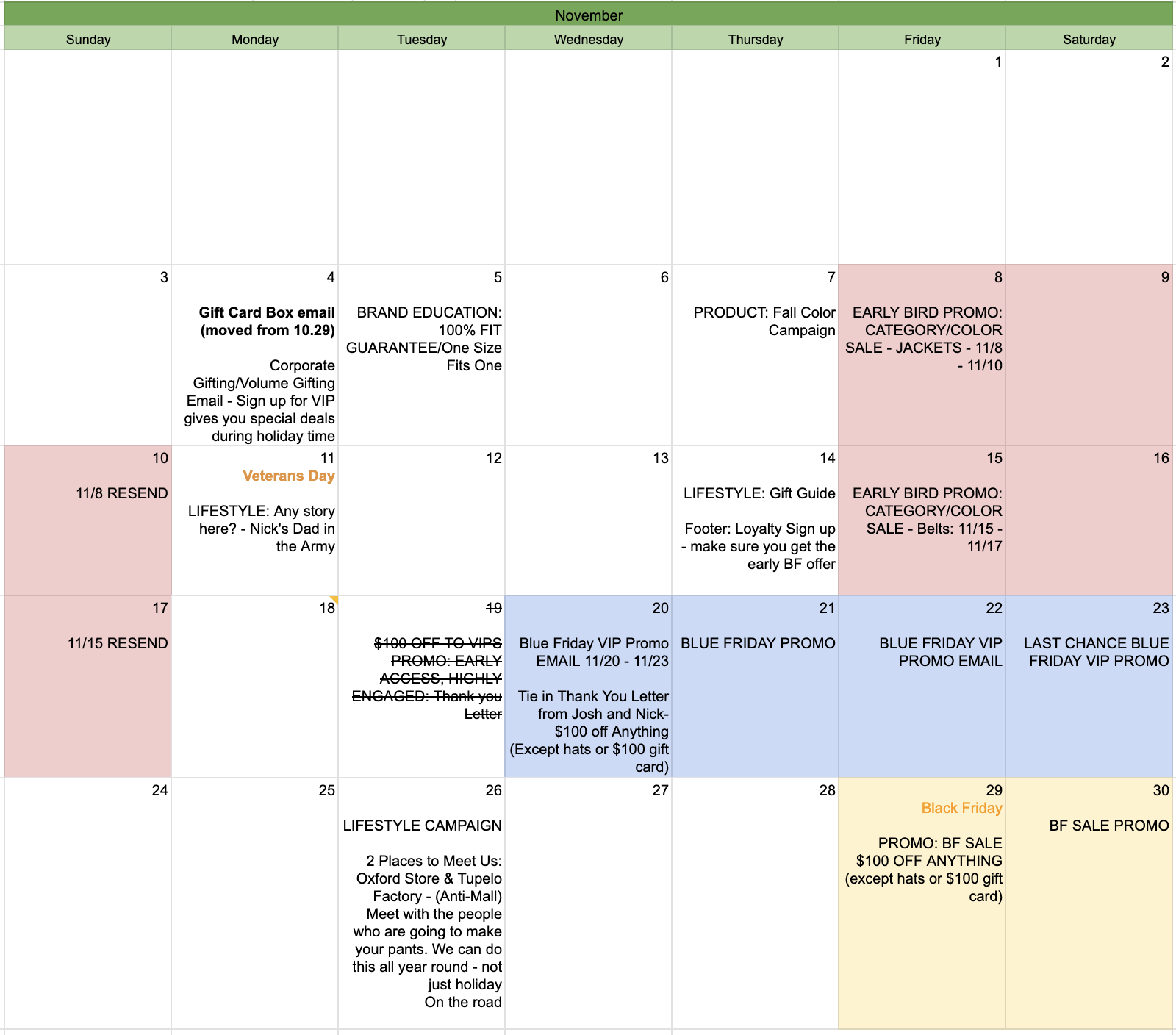
Caption: A Q4 email calendar mapped in August gives you room to plan segmentation and warm up your list before peak season.
Step 2 — Layer in your promotional strategy
With the fixed dates locked, decide what you're actually offering and to whom. Map out your discount structure (or your no-discount value adds), which products you're pushing when, and how each offer builds on the last. A strong Q4 promotion is a sequence, not a single email: a teaser, an early-access window for your best subscribers, the main event, and a last-chance close.
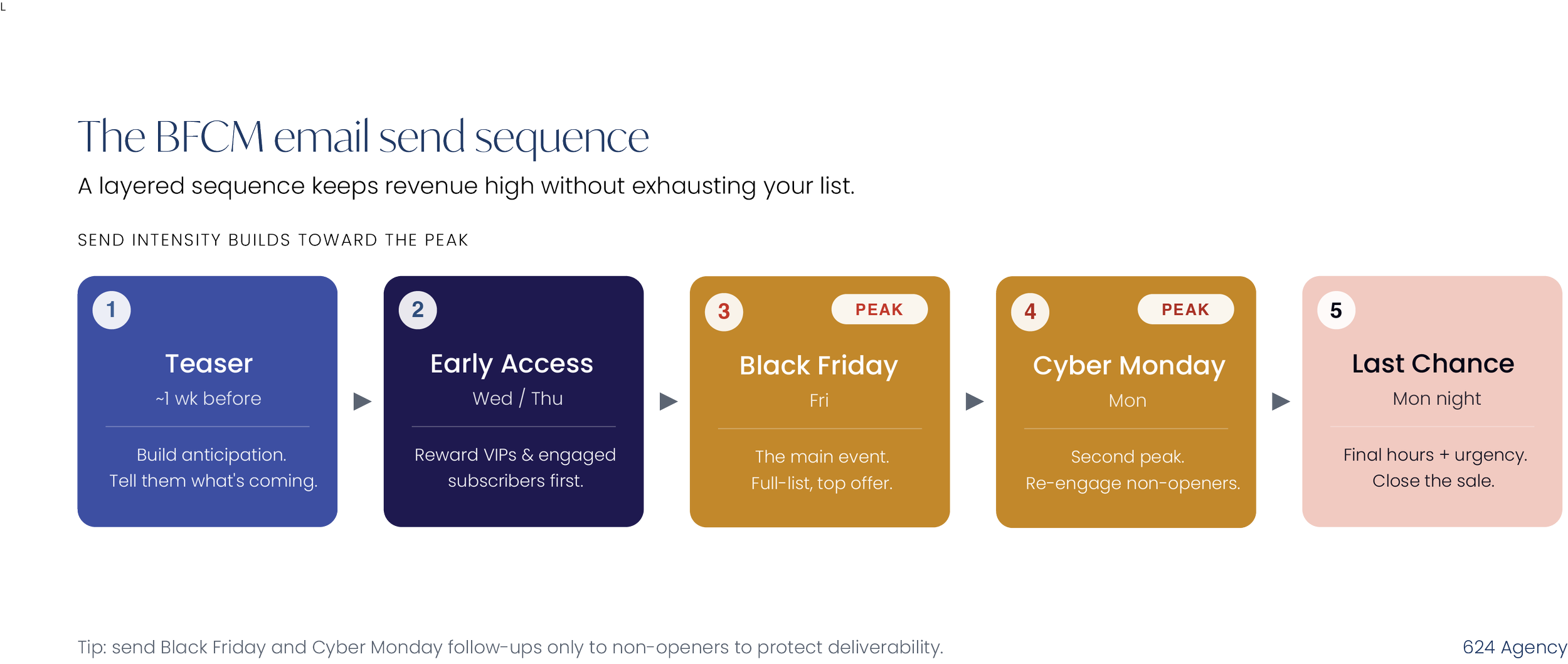
Caption: A layered send sequence keeps revenue high without exhausting your list.
Step 3 — Build in the warm-up
Your list is only as valuable as it is engaged and deliverable. In September and October, focus on growing your subscriber base and priming it: run list-growth offers, clean out chronically unengaged contacts, and start sending consistently so the mailbox providers see you as a trusted sender well before your volume spikes. Warming up now means your Black Friday sends actually land in the inbox.
Step 4 — Plan your segmentation
Batch-and-blast is the single biggest revenue leak in Q4. Sending every email to your entire list hurts deliverability, annoys your best customers, and wastes the data you already have. At minimum, plan to segment by engagement (recently engaged vs. dormant), by purchase behavior (first-time, repeat, and lapsed buyers), and by early-access status for VIPs. You don't need dozens of segments; you need a handful that let you send the right offer to the right people.
Step 5 — Protect your deliverability
As send volume climbs, deliverability gets fragile fast. Protect it by leaning on your engaged segments during the busiest weeks, keeping a sunset flow running to suppress subscribers who never open, and ramping your volume gradually rather than jumping from two sends a week to daily overnight.
Step 6 — Don't forget the flows
Your campaigns get the attention, but your automated flows quietly do a huge share of Q4 revenue. Before the rush, review and prep your welcome series, abandoned cart, browse abandonment, and post-purchase flows for peak traffic. Make sure the offers and copy match your holiday promotions, and confirm everything is actually firing. A working abandoned-cart flow during BFCM is one of the highest-ROI things on this entire list.
Step 7 — Plan the post-holiday window
Most brands go quiet on December 26 and leave money on the table. The week between Christmas and New Year is full of gift-card redemptions, self-gifting, and highly engaged buyers. Plan a short post-holiday sequence — a thank-you, a gift-card or new-arrivals push, and a new-year reset — so you capture demand your competitors are ignoring.
What a realistic Q4 send cadence looks like
Cadence should build toward your peak, which is likely around the Black Friday/Cyber Monday period. For example, for a designer brand generating $3 million in revenue that’s currently sending three campaigns a week, a reasonable arc may look like this:
Three campaigns a week in early October
Ramping to four a week in late October
Daily (or near-daily) sends at the launch of the Black Friday promotional campaign
Twice daily sends during Black Friday weekend - Cyber Monday
Then easing back to three or four a week through mid-December and the shipping-cutoff push
The exact numbers matter less than the principle: build up, peak at the promotions, and lean on segmentation so no single subscriber feels buried. And always exclude people once they’ve purchased, unless there’s a reason to email them again (i.e. you’re introducing something new to the offer).
Build the plan before the rush
A great Q4 comes down to preparation. Map your dates, layer your promotions, warm up and segment your list, protect your deliverability, and prep your flows — all before the season starts. Do that, and the busiest quarter of the year becomes the one you feel most in control of.
Want a Q4 email calendar built for your brand before the rush? Let's map it out — book your complimentary strategy call.
FAQs
When should I start planning my Q4 email calendar?
Start in August or September. Planning your Q4 email calendar this early gives you time to grow and warm up your list, test offers, and prep your flows before send volume spikes. Waiting until Q4 forces every decision under pressure, which is where deliverability and revenue both suffer.
How many emails should I send during Black Friday and Cyber Monday?
Most ecommerce brands send daily, and sometimes twice daily, across the Black Friday through Cyber Monday window. High frequency works during this period because purchase intent is at its peak, but it only works if you're sending to engaged segments and have warmed up your list beforehand.
What percentage of Q4 revenue should come from email?
Email typically drives 20-30% of total revenue for a healthy ecommerce brand, and that share often runs higher in Q4 when your list is most engaged. If your email revenue is well below that range, Q4 is the most expensive time to have that gap.
How do I avoid hurting my deliverability when I increase send volume in Q4?
Warm up your list before the rush, prioritize your engaged segments during peak weeks, keep a sunset flow suppressing chronically unengaged subscribers, and ramp your volume gradually instead of spiking overnight. These steps protect your sender reputation so your holiday sends reach the inbox.